
Invoker Tornado + EMP: Preparation and Practice
Prepare Tornado and EMP, reuse the orb queue, plan the landing window and diagnose missed EMPs with a repeatable practice routine.
Updated
Maintained by InvokerGameOn this page
- When to use it and what to check
- Separate recipes, queues and slots
- Why QWW is a better starting order for EMP
- Choose a preparation method
- Work backward from the landing window
- Hero Demo: build a stable sample in four steps
- Diagnose input, position, timing and coordination
- Record one block of practice
- Evidence and patch boundaries
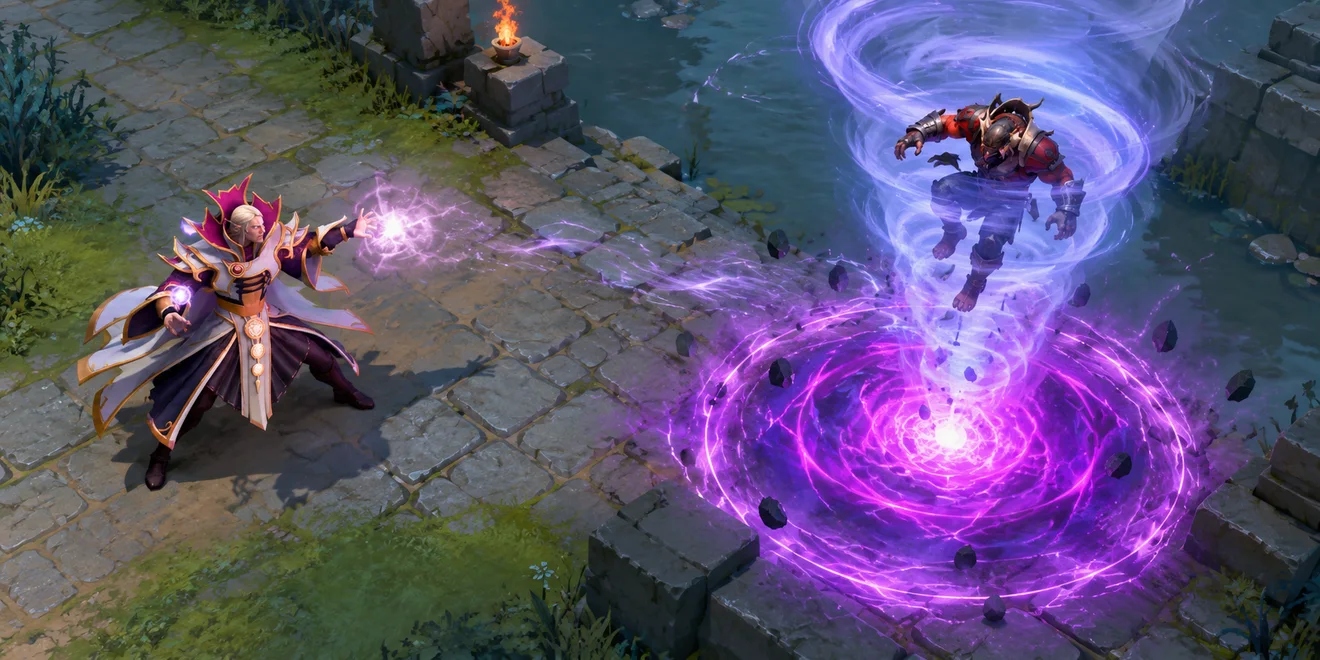
Tornado + EMP asks you to prepare the right slots, cover the landing position and make the detonation meet a vulnerable target. Preparation order, cast order and effect order are three different things. Start with the reproducible queue and slot examples below, then test position and timing in Dota 2 Hero Demo.
When to use it and what to check
Situation: A target occupies a controllable area
- Intended purpose
- Use the control window to arrange EMP
- Check before committing
- Does EMP cover the landing position?
Situation: Several opponents cross a narrow area
- Intended purpose
- Apply mana pressure in that area
- Check before committing
- Who will actually be lifted, and who can leave?
Situation: An ally will follow with control
- Intended purpose
- Coordinate the landing window
- Check before committing
- Avoid placing the ally's effect inside the lift
Situation: Allies are already dealing damage or controlling the target
- Intended purpose
- Decide whether Tornado is needed
- Check before committing
- Would lifting interrupt a working damage window?
Check spell and Invoke cooldowns, mana, range, vision and the target's current immunity or protection. Lit icons alone do not establish that the effects will work; verify specific interactions in the current client. The combination can create room for follow-up actions, but does not guarantee damage or a kill.
Separate recipes, queues and slots
The example uses Q/W/E orbs, R for Invoke and D/F spell slots. The orb set determines the recipe; its order determines which orb the next input removes.
Start / goal: Empty queue and slots → prepare Tornado
- Inputs
Q W W R- Resulting queue
QWW- New slot D
- Tornado
- Older slot F
- Empty
Start / goal: Keep the queue → prepare EMP
- Inputs
W R- Resulting queue
WWW- New slot D
- EMP
- Older slot F
- Tornado
1. After Tornado Invoke
QWW RD TornadoFEmpty
2. After EMP Invoke
+ W RD EMPFTornado
The second Invoke puts EMP in D and moves Tornado to F. From this exact state, F casts Tornado and D casts EMP. This identifies the keys; it does not prescribe the interval between casts. Existing spells, another Invoke or different bindings require you to read the slots again.
Why QWW is a better starting order for EMP
Starting queue:
QWW- After adding W
WWW- Spell
- EMP
- Still required
- R to Invoke
Starting queue:
WWQ- After adding W
WQW- Spell
- Tornado
- Still required
- Two more W inputs to reach WWW
From empty, Q W W R W R uses four orb inputs and two Invokes. Rebuilding both three-orb recipes uses six orb inputs. Neither count includes D/F casts, aiming or mouse actions, and neither describes the combo's elapsed time in a match.
Test Tornado into EMP
Add W from QWW, then add W repeatedly from WWQ and compare the paths.
Q → W → W
Current recipe: Tornado
Choose a preparation method
Method: Prepare both spells in advance
- Approach
- Use the table, then read D/F
- Benefit
- Fewer recipe inputs during the cast window
- Constraint
- Later Invokes can change slots; check actual cooldowns
Method: Prepare and cast one, then switch to the other
- Approach
- Finish the remaining preparation between effects
- Benefit
- Trains switching and state tracking
- Constraint
- Inputs, turning and Invoke availability consume the window
Start in Hero Demo with both spells ready to remove recipe errors, then practise preparing during the sequence. Browser Combo checks the requested Invoke sequence. Passing Tornado → EMP there does not prove a successful cast sequence or hit.
Work backward from the landing window
Tornado hits → lift → landing
EMP release → delay → detonation
↑ Landing window
Set time zero when the target is actually lifted, not when you press F. Let L be the observed lift-to-landing duration, E the EMP release-to-detonation delay, C the preparation time from starting your input to EMP release, and δ a desired small margin after landing.
EMP input time = L - E - C + δ
This relationship helps plan an experiment; it is not fixed patch data. For a hypothetical L = 2.0 s, E = 2.5 s, C = 0.2 s and δ = 0.1 s, the result is -0.6 s: begin the EMP input 0.6 seconds before the target is lifted. These numbers are arithmetic examples, not current game parameters.
Tornado hitting first therefore does not mean Tornado must always be cast first. A negative result calls for planning EMP before the lift. Tornado also travels, so planning from your keypress requires accounting for range, turning and actual release. Observe a fixed-distance setup before selecting your cast order rather than copying an uninterrupted key string.
Hero Demo: build a stable sample in four steps
- Fix the conditions. Record levels, talents, inventory, cast settings, target and approximate range. Use a stationary target first. Verify mana, cooldowns and D/F.
- Calibrate position. Land Tornado and observe where the target returns. Place EMP so that its area covers that point. Do not chase faster inputs yet.
- Adjust timing. Make five attempts with the same setup. Record whether detonation is during the lift, near landing or clearly after it. Change only EMP release timing in the next block.
- Add variables gradually. Keep levels fixed and test another range; then add movement. Change levels or equipment in separate blocks so the cause of failure remains identifiable.
Five attempts is a convenient review block, not a statistical significance threshold. Explain the failures before increasing execution speed.
Diagnose input, position, timing and coordination
Category: Input
- Symptom
- Wrong spell casts
- First check
- D/F and the last Invoke
- Change for the next block
- Read slots slowly before pressing
Category: Input
- Symptom
- Cannot prepare EMP after Tornado
- First check
- Ordered queue and Invoke availability
- Change for the next block
- Recreate the same starting queue
Category: Position
- Symptom
- Target lands outside EMP
- First check
- EMP centre, landing point, movement
- Change for the next block
- Keep timing fixed and adjust placement
Category: Timing
- Symptom
- EMP explodes during the lift
- First check
- EMP is too early relative to landing
- Change for the next block
- Release EMP later and repeat
Category: Timing
- Symptom
- Target lands and leaves before detonation
- First check
- Late EMP or off-centre placement
- Change for the next block
- Confirm placement, then release earlier
Category: Range
- Symptom
- Only works up close
- First check
- Travel, turning and preparation
- Change for the next block
- Keep levels fixed; change only range
Category: Coordination
- Symptom
- Ally's effect misses during the lift
- First check
- Allied control and damage order
- Change for the next block
- Agree on the post-landing window
If position and timing appear correct but the effect still fails, check protection states and current patch interactions. Do not attribute every failure to typing speed.
Record one block of practice
Conditions: Levels, talents, inventory, range
- Starting state
- Queue; D / F
- Placement
- Does the area cover the landing point?
- Detonation relative to landing
- Early / close / late
- Result / next adjustment
- Did it affect the target? Choose one adjustment
Use Combo mode to verify the four-orb path, Combat mode for different slot states, and Hero Demo for position and timing. Schedule these with the 15-minute routine. Use the recipe cheat sheet for other spells and QW versus QE for broader playstyle decisions.
Evidence and patch boundaries
Recipes, queue reuse and D/F examples follow this site's trainer and can be reproduced in the lab. This article does not claim a current-client experiment or permanent timing, damage or upgrade values. Consult the official hero page, official patch notes and current tooltips. Repeat your measurements after changing levels, talents or inventory.
Related reading
Combos and execution
Invoker Eul Combo: Timing, Slot Preparation and Practice
Learn how to prepare Sun Strike, Chaos Meteor and Deafening Blast, calculate landing windows, diagnose missed casts, and separate browser drills from Dota 2 Demo practice.
Practice and learning
A 15-Minute Invoker Practice Routine
A practical Invoker training session: review recipes, practise queue reuse and slots, then check one combo in Dota 2 Hero Demo.