
Race leaderboard standards
The eligibility, timing and moderation rules used by the Invoker Game race leaderboard.
Updated
Why the standard changed
In September 2026, the board received runs of 2.37 seconds with 43 misses and 2.49 seconds with 124 misses. Those results require at least 22.4 and 53.9 Invoke attempts per second, even before orb presses are counted. Nearby leading runs averaged about 2.0–2.5 Invoke attempts per second.
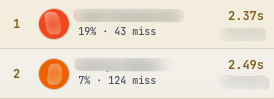
The two runs as they appeared on the public board before the standard changed. Player names are blurred.
The anomalous records have been retained for audit, marked as flagged, and removed from public ranking. Player names are omitted here because the data shows an anomaly, not how it was produced.
What qualifies
A race appears on the global leaderboard only when all of these conditions are met:
- The player is signed in and invokes all 10 spells with recipe hints off and without pausing.
- Accuracy is at least 80%. With 10 required spells, this allows at most two misses.
- Official time is measured by a one-use server attempt and is between 3.50 and 180 seconds.
- The reported total of orb presses and Invoke attempts does not exceed 15 actions per second.
Every completed run still remains in the player's local browser history. These standards only decide whether a result enters the public board.
Server timing and automation
Starting a signed-in race creates a one-use attempt on the server. The leaderboard uses elapsed server time rather than accepting the browser's claimed time, and a completed attempt cannot be submitted again.
Automation is not categorically prohibited. A script is judged by the same measurable limits as any other input method. Runs below the plausible time floor, below the accuracy requirement, or above the action-rate limit do not enter the board.
Moderation
Leaderboard records have two states: ranked and flagged. Flagged records stay in the database with a reason and review time but are hidden from public ranking. If that player later completes an eligible race, the valid result can replace the flagged record even when its time is slower.
The thresholds may be adjusted when broader data shows that a limit excludes credible human play or admits clearly implausible results. Material changes will be recorded on this page.
Related reading
Keybinds and mechanics
Invoker Hotkeys: Legacy, QWER and Quickcast Practice Guide
Choose a comfortable Invoker layout, compare cast confirmation methods, avoid item and unit-control conflicts, and test six trainer bindings with a repeatable practice routine.
Combos and execution
Invoker Eul Combo: Timing, Slot Preparation and Practice
Learn how to prepare Sun Strike, Chaos Meteor and Deafening Blast, calculate landing windows, diagnose missed casts, and separate browser drills from Dota 2 Demo practice.